Wednesday, November 4, 2015

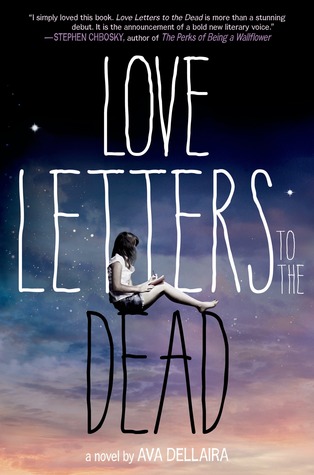
Letters to Heal a Broken Heart


“Maybe when we can tell the stories, however bad they are, we don’t belong to them anymore. They become ours.” (297).


This quote communicates a main character’s discovery of her reason for writing letters, which she never intends anyone to read, in order to process the life-altering events in her life. Laurel, the main character in Love Letters to the Dead by Ava Dellaira, is reeling from the recent death of her older sister May. Feeling lost, confused, and totally devastated, she begins to journal about her thoughts and feelings in the form of letters to various famous people who have passed away. Through her letters she makes unexpected discoveries about her life, and is able to come to terms with past events that she was previously too terrified to confront. Teenagers reading this story will connect to Laurel’s journey to find her place in a world that has been turned upside down.

To begin with, sometimes people feel out of place in their own lives. Like they don’t fit into the idea that they have, or someone else has, about how life should be. I would go as far as to say that each and every one of us experiences this at least once in our lives, and for some of us it is more like a near constant feeling of never fitting in. If you connect with this idea at all you will find yourself identifying with Laurel’s struggle to find meaning and beauty in the many challenges she faces. One quote from the book that I really related to was when Laurel states “And maybe what growing up really means is knowing that you don't have to be just a character, going whichever way the story says. It's knowing you could be the author instead.” (165). Laurel finally discovers that she can choose her own path in life instead of worrying about fitting into someone else’s idea of how she should think or act. How great is that? While reading this story, I found myself connecting to so many quotes and ideas.  The previous example is just one of many of the realizations that Laurel has throughout the book.

All in all, I think that anyone can find something that resonates with them in this story, whether they have experienced a recent or past traumatic event, or even if they are simply experiencing the big changes that accompany transitions from one school to another.  During times like these it is so easy to feel confused and lost and to question our actions and ourselves. It is so important to find stories like this one to identify with in order to prevent these changes from making us feel overwhelmed and alone.

Monday, December 15, 2014

A Dream That Doesn't Need a Cure


“Why is a woman to be treated differently? Woman suffrage will succeed, despite this miserable guerilla opposition.” –Victoria Woodhull


Women’s suffrage was legalized in the United States in 1919. Before it that many women fought tirelessly for equal rights for women, including the right to vote. The Cure for Dreaming by Cat Winters is a story about Olivia Mead, a teenager growing up in the early 1900s who feels trapped by the limited expectations for her as a girl. She wants to pursue an education and follow her dreams of having a career. This isn’t easy for her as she lives in a time when society’s expectations for women are limited to caring for a household only. It doesn’t help matters that her father is adamant about her quitting school and working full time to care for him and their home after her mother leaves to pursue her own dreams of becoming an actress. The local suffrage movement, an interest that ultimately puts her in danger, intrigues Olivia. This interest also ignites a fire in her that prompts her to risk everything for what she believes in. The main character’s feelings about women’s suffrage are greatly influenced by the other characters in the book, especially her father and the suffragettes. 

When Olivia’s father finds out that she attended a protest for women’s suffrage he hires a hypnotist named Henri Reverie to hypnotize Olivia so that she is forced to “...accept the world the way it is” (59). In other words, to accept that her place in life is to stay at home and take care of him and the house. This works to a certain extent, but an unexpected side affect of the hypnotism is that she gains the ability to see people for who they really are. She discovers that her father is a sadist, and that he drove her mother away because he tried to hold her back from pursuing an acting career. She sees that he is doing the same to her. Instead of holding her back, his actions only make her convictions stronger. She wants to be part of the movement for women’s rights. She stays true to who she is and stands up to her father in order to continue on a path that she believes to be right for her, and for all women. This prompted me to contemplate important social movements and protests happening today.

Although women have gained the right to vote and much has changed since the early 1900s, equal rights for women is still an important issue. For example, on average women still make only seventy cents for each dollar a man makes. Olivia is a character who was ahead of her time in her thinking. Although just a teenager, she was drawn to the work of the suffragettes, and longed to join them in their protesting. Most people at the time thought that their efforts were futile, and that they were simply a bunch of silly women with too much time on their hands. Olivia was inspired by their determination and could see the importance of their work even when the progress they were making was difficult to see. At the end of the story she expresses that “There’s much hope. There’s so much work too-ridiculous amounts of work-but above all, hope.” (337) I think people can learn a lot from this book about how change takes time and effort to happen, especially when it comes to civil rights issues.


Olivia Mead is an example of a strong character who grows even stronger in her convictions from the influence of other characters in the story. The main character’s dedication to women’s rights is admirable. I learned a great deal about resilience and not giving into the pressures of those around you, even close family members.  Others can connect to this idea because everyone is influenced in some way by various people in their lives. It can be difficult to discern sometimes whether those influences are positive or negative. We can learn a lot from those around us, however it is important to stay true to yourself.

Thursday, December 11, 2014

Reading Response: Out Of The Tunnel by Patrick Jones


“The game of life is a lot like football. You have to tackle your problems, block your fears, and score your points when you get the opportunity.” -Lewis Grizzard

Have you ever wanted something so much that you would go to any length to get it? Most people think high school football is just about playing games. But what about everything that happens off the field? Navigating relationships, understanding the hierarchy of players on the team, and trying to fit in without jeopardizing your spot on the team are a few of the things that make playing on a team more complicated than it seems. Out of the Tunnel by Patrick Jones is a story about Brian, a character who has just been promoted to the “Big Six” on his high school football team. This means that his position has changed from the more minor position of linebacker to tight end, one of the most important positions on the team. This also means that he is now a part of a group of six players who others view as the best. They get preferential treatment by just about everyone, including their head coach.  Throughout the events in the story Brian’s feelings about being a part of the Big Six change significantly.

The story begins with Brian feeling excited, yet conflicted about being chosen as tight end for his football team. He likes his current position of linebacker but his dad is pressuring him to play tight end. Being tight end means more than just an important position on the field. As the story continues Brian realizes that his social obligations off the field are important to the other members of the Big Six. This includes attending parties where underage drinking is happening. Being the newest member of the Big Six, Brian is pressured to provide alcohol for these parties, or else he risks being disliked by his older teammates, which could jeopardize his new position on the team. I think Brian gives into the peer pressure he is facing because he wants to impress his father. He realizes that both his father and his coach are aware of the parties that happen because they used to do the same things when they played high school football. He is disappointed in the fact that this is overlooked when it comes to important players on the team, because it is clear that he does not want to participate in all the social activities that go along with being a starting player in a key position on his team. He is realizing that this position comes at a price.

Will Brian continue to “pay the price” to keep his position as tight end? In the story Brian’s emotions have ranged from excitement, hesitation, fear and disappointment as he realizes just what it takes to be a part of the football team. Many people can connect to this idea of having mixed feelings while being peer pressured to participate in something questionable. Teenagers especially encounter peer pressure, whether it relates to sports or not. It is up to them to decide if what they are pressured to do is worth the consequences. This is an important idea to keep in mind throughout life, as people of all ages will face decisions with consequences.

Thursday, October 23, 2014

Broken Glass Park by Alina Bronsky

"Sometimes I think I'm the only one in my neighborhood with any worthwhile dreams. I have two, and there's no reason to be ashamed of either one of them. I want to kill Vadim. And I want to write a book about my mother." -Alina Bronsky Broken Glass Park


In life it is important to dream big and follow your heart. But what if your dreams have been defined by an unimaginable tragedy that dramatically changes your life forever? The book Broken Glass Park by Alina Bronsky introduces us to Sascha Naimann, a strong, witty, and determined 17-year-old Russian immigrant living in the rough outskirts of Berlin. She has recently witnessed the murder of her mother by the hands of her abusive stepfather. Sascha has vowed to avenge her mother's death in two ways. First, by killing her (now jailed) stepfather, and then by writing a book about her, although she has no clear plan for how she will accomplish either of these things. This highly affecting story is a powerful example of how uncontrollable life circumstances might begin to define a person, but that ultimately each of us is in control of our own destiny.

Destiny is a funny thing. Some believe that destiny is set for each individual and that life itself is predetermined by some greater power. Others believe that we control our own destiny and that life choices, rather than a higher power, determine who we become and where our lives take us. This story made me think a lot about life's destiny, but Sascha Naimann is too lost in her grief to consider it. Though she is an incredibly bright, headstrong young woman, horrible life events and a very difficult living situation hold her back from focusing her attention on herself, and on leading a normal teenage life. Her number one objective in life is to kill Vadim, the man who murdered her mother, regardless of the consequences.

Throughout the story Sascha repeatedly refers to her plan to kill Vadim. For example, in the beginning of the book she tells her little brother "There's a thousand ways I could do it. I could poison him, suffocate him, strangle him, stab him, push him off a balcony, or run him over with a car." (pg. 19).  Avenging her mother's death becomes an obsession; she thinks of little else. Until one day a small headline in the daily newspaper reveals something that renders her plan impossible. She is enraged, heartbroken yet again, and uncertain of a direction in her life. At this point in the story it becomes clear to me that she has never had the chance to really consider what she wants for herself in life. As a child she endured abuse, racism, and being uprooted from her homeland only to land in an even worse living situation. Then, on the cusp of becoming an adult, the murder of her mother turns her focus even further from herself.

Still, Sascha's life is far from over. As she starts to let go of the demons from her past she begins to open her eyes to life's possibilities, and most importantly what she wants to do for herself. This book prompted me to reflect on my own life and how easy it is to put the needs and wants of others before my own, and to lose sight of what I truly value in life. I think many others can relate to this idea because it is easy to become consumed with pointless pursuits and worries at the detriment of ourselves and those around us. Without fail life with supply us with plenty of hardships, but we all have the ability to continue to make choices that help ourselves along on the life path we truly wish to lead.


Saturday, October 4, 2014

"Ashes" Reading Response (Final Draft)


“Children begin by loving their parents; as they grow older they judge them; sometimes they forgive them.”  -Oscar Wilde, The Picture of Dorian Gray

When I was growing up I remember believing that my parents always knew best and that they were incapable of making mistakes. However, as a teenager I realized that my parents, like every other human being, did indeed make mistakes and also made decisions that I didn’t always agree with.  “Ashes” by Susan Beth Pfeffer tells the story of Ashleigh, a high school student who, shuffled between divorced parents, is about to meet her father for what she believes will be a typical evening together. Instead, as this short story unfolds, Ashleigh’s father asks her to borrow two hundred dollars for him from her mother who keeps this money hidden at her house for emergencies. He is secretive about why he needs it, disclosing only that he owes money to some shady characters. Still, he promises he will return the money and her mother will never know. This interaction prompts Ashleigh to begin to view her father differently than she ever has before. The author of this story uses celestial symbols to represent how Ashleigh’s view of her father changes throughout the story.
                The story opens with Ashleigh describing how she feels about her father when she sees him. In the first sentence she states that “Every time I saw my father, the sun cast off just a little more warmth than it had the day before,” (pg. 225).  The author is using the sun to represent how excited Ashleigh is to see her father. She spends most of her time with her strict mother. When she is with her father her life feels more spontaneous and exciting. Her father is described in the story as a dreamer who, although might be considered irresponsible in many ways, ultimately has a kind heart. This is significant because these are characteristics about her father that Ashleigh feels are admirable.
As the story progresses we start to see how Ashleigh is reflecting on moments in her life when her father was not always reliable. The author uses the symbol of a necklace made of stars to show us how Ashleigh’s father did not always keep promises that he made to her. Although he might mean well, her father often promised her things that never materialized. In one part of the story the author compares how Ashleigh never got the necklace made of stars to how she and her mother often did not get child support checks. This leads to a turning point in the story when Ashleigh and her father are having dinner and he asks her if she will take the money from her mother for him. Ashleigh is clearly uncomfortable about this and conflicted about what to do. She loves her father but she also knows that he doesn’t always keep his promises. It’s possible that if she takes the money her father will not keep his promise to return it.
As the story comes to a close Ashleigh’s father is giving her a ride home after dinner. There is tension in the car because Ashleigh feels uncomfortable with what her father is asking her to do. At this point the author uses the moon to convey the tone in the car when she states in the story that “For a moment, a cloud drifted past the moon and the sky turned a greenish gray,” (pg. 229).  Just as the sun’s rays painted a picture of happiness and excitement, the clouds, moon and dark sky symbolize the change in Ashleigh’s view of her father. She is beginning to question his integrity and character. Although her father has been unreliable in the past, she has for the most part ignored those traits because she loves him. However, he has never before asked her to lie to or steal from her mother, and this change is forcing her to question his integrity.
The author’s use of celestial symbols throughout the story effectively helps to convey how Ashleigh begins to view her father differently. At the beginning of the story the author uses the image of the sun to support that Ashleigh is filled with nothing but love for her father.  By the end, the author uses the image of clouds over the moon to help describe that Ashleigh is discovering she can no longer completely ignore her father’s shortcomings, and that she doesn’t completely agree with his ideas. Others can connect to this story because many people experience a changing view of a loved one. This might be a parent, friend or relative whose judgment is questioned when before it was always trusted. At some point in our lives we are all faced with the realization that people are not always who we envision them to be. It is important to trust our instincts, and to sometimes question the judgment of others, even those we love.

"Ashes" Reading Response (First Draft)

A note to my students about this post: This is my first draft. In class I demonstrated how I changed my draft as we moved through our writing lessons this week. The following includes many of my revision notes (highlighted in yellow and green), however it does not include all of the revisions I made. Check out my next post to see all of the changes I made before I published my final draft. I'm looking forward to reading your drafts next week (due Tuesday 10/7) before you post them to your blogs! Also, I encourage comments and feedback since we are all familiar with this short story.


"Ashes" First Draft with Revision Plan:

 Add HOOK!


“Ashes” by Susan Beth Pfeffer tells the story of Ashleigh, a high school student who, shuffled between divorced parents, is about to meet her father for what she believes will be a typical evening together. Instead, as this short story unfolds, Ashleigh’s father asks her to borrow two hundred dollars for him from her mother who keeps this money hidden in a (supposedly) secret location at her house. Ashleigh (“Ashes”) is conflicted about taking the money for her father.  He is secretive about why he needs it, disclosing only that he owes money to some shady characters. Maybe change wording of last sentence? Still, he promises he will return the money and her mother will never know. This interaction prompts Ashleigh to begin to view her father differently than she ever has before. In this story the main character’s feelings about her father change a lot. Make my claim stronger. Maybe focus on celestial symbolism from story? Start new paragraph after claim
 In the beginning of the story Ashleigh describes how she feels excited to see her father on Tuesdays, the only day she gets to see him. She spends most of her time with her strict mother, and when she is with her father her life is more spontaneous and exciting. I need textual evidence here- maybe use the symbol of sun representing her love for her father? Her father is described in the story as a dreamer who, although might be considered as lacking focus and irresponsible in some ways, ultimately has a kind heart and believes that he can rest easily at night if he feels he has helped at least one person that day. This is significant because these are characteristics of her father that Ashleigh feels are admirable. In the middle of the story Ashleigh and her father are eating dinner together at a diner. This leads to turning point in the story when her father asks her to take the money from her mother without her knowing about it. Ashleigh is clearly uncomfortable about this and conflicted about what to do. She loves her father but she doesn’t want to lie to her mother.
Add a paragraph here. Use symbol of necklace made of stars to support the idea that Ashleigh’s father does not always keep his promises, ie child support checks, late to pick her up, etc.
As this story comes to a close Ashleigh’s father is giving her a ride home after dinner. There is tension in the car because Ashleigh feels uncomfortable with what her father is asking her to do. She is beginning to question his integrity and character. Although her father has been unreliable in the past, she has for the most part ignored those traits because she loves him unconditionally. However, he has never before asked her to lie to or steal from her mother, and this change is forcing her to question his integrity. She is forced to decide for herself whether or not if she will steal the money from her mother for him.  Although we don't find out exactly what Ashleigh decides to do about the money, one thing we know for sure is that this experience has resulted in a change is how she views her father. I need to elaborate on how this causes her to question her father’s integrity. I also need to add evidence to the beginning of the paragraph- perhaps the symbol of the cloud moving over the moon?
WRITE CONCLUSION! Restate claim, add personal connection and why this matters to others.

                **NEED MORE ELABORATION AND CONNECTIONS TO CLAIM IN BODY PARAGRAPHS!